
Conservatory Roof Coverings and Types Explained
Solid, tiled, warm and insulated are four words the trade uses interchangeably, and they do not mean the same thing. One is a construction method, one is a finish, one is a retrofit and one is a weight claim. Here is what each covering is, what it costs on a 3m by 3m conservatory, and what it reaches in W/m²K.
Replacement roof covering · existing 3m × 3m conservatory · installed, inc VAT
£1,900 to £11,000 by covering, not by size
Mixed gradesPolycarbonate £1,900 to £3,500, glass £2,000 to £7,000, tiled or solid £6,000 to £11,000. Sources and grades row by row below. Checked 20 August 2026.
What are the types of conservatory roof covering?
Seven words are in common use and they describe four things. Polycarbonate and glass are glazing materials. Tiled is a finish. Solid is a category. Warm roof describes where the insulation sits, insulated usually means a retrofit to the roof you already own, and lightweight is a weight claim rather than a material. Prices below are for an existing 3m by 3m conservatory, installed and including VAT, each with its own evidence grade. For the whole job rather than covering by covering, see conservatory roof replacement cost.
| Covering | Low | Typical | High | Evidence | Source and date |
|---|---|---|---|---|---|
| Polycarbonate, like for like | £1,900 | not published | £3,500 | Reasonably | One UK publisher 27 Jul 2026, Homebuilding 18 Apr 2024 |
| Glass, sealed double-glazed units | £2,000 | £4,000 | £7,000 | Reasonably | Four independent UK publishers |
| Tiled or solid, insulated system | £6,000 | £8,075 | £11,000 | Well | Four independent UK publishers |
| Insulating the roof you already have | £1,050 | not published | £2,750 | Thin | One UK publisher, 2 Jul 2026 |
Sources: six publishers. One of them prices three rows (tiled page 2026, polycarbonate and glass 27 July 2026, insulation 2 July 2026); four more are dated July 2026, a table updated December 2024, undated, and 25 December 2025; and Homebuilding is 18 April 2024. The tiled typical of £8,075 is derived as the median of five sourced point estimates; the glass typical of £4,000 is one publisher's point estimate, not a midpoint. The insulation band is a single publisher and is graded Thin for that reason. Checked 20 August 2026.
Polycarbonate: what you probably have now
Multiwall polycarbonate is a plastic sheet with hollow flutes running through it, and it is what most conservatories built between the late 1980s and the mid 2000s were glazed with. UK stock thicknesses run 4, 10, 16, 20, 25, 32, 35, 40 and 55mm; Ultraframe's standard conservatory range is 25mm or 35mm.
The failure modes are always the same four: it gains heat in summer, loses it in winter, drums in rain, and goes green as algae colonises the flutes and the sealing tapes give up. None of that is a defect. It is what a thin plastic sheet does after twenty years on a south-facing roof.
Replacing it like for like is the cheapest thing you can do to a conservatory roof, at £1,900 to £3,500 for a 3m by 3m, Reasonably evidenced from one UK publisher (27 July 2026) and Homebuilding (18 April 2024), checked 20 August 2026. It buys back the watertightness and the appearance and changes nothing about the temperature. The decision, and the three prices it turns on, sit on replace polycarbonate conservatory roof.
Glass: units, coatings and what they actually do
A glass conservatory roof is a set of toughened sealed double-glazed units in a glazing bar system, and the unit specification rather than the word "glass" decides what you get. Clear with clear and an air fill sits at 2.7 to 2.8 W/m²K, barely better than the polycarbonate it replaced. A real-world roof unit with argon, low-E and a warm-edge spacer lands at 1.0 to 1.3 W/m²K centre pane, on Clayton Glass published data.
Two coatings get sold alongside it. Self-cleaning glass carries a photocatalytic and hydrophilic coating on the outer face, measured against EN 1096-5, and the manufacturer's own maintenance sheet is blunter than any installer will be: it is explicitly not a maintenance-free product. Solar-control glass is measured by g-value alongside U-value, and the trade-off is always light. Across the Pilkington Suncool range, g falls from 0.42 to 0.17 while light transmission falls from 70 per cent to 28 per cent.
A new glass roof runs £2,000 to £7,000 at 3m by 3m, typically £4,000, Reasonably evidenced across four publishers, checked 20 August 2026. Spec, size bands and the coating decisions are priced on replacement glass roofs for conservatories.
Solid: a category, not a product
"Solid" tells you only that the roof is opaque. It says nothing about how it is built, what it weighs or what it reaches thermally. In practice a solid replacement is an insulated panel or rafter system, finished with lightweight tiles, slates or GRP outside and plasterboard inside. Published system U-values across the eight named systems run 0.10 to 0.18 W/m²K, and 0.15 is the market entry point because 0.15 is the England compliance floor for a replacement roof under Approved Document L Table 4.2.
The important consequence is legal rather than thermal: fitting one means the structure stops being an exempt conservatory, which turns the job into notifiable building work.
Named systems are where the price conversation usually starts, and the eight compared side by side, with their certificate numbers and validity windows, sit on conservatory roof systems. What a solid roof adds, what it saves and what it costs you in daylight is priced at the cost of a solid conservatory roof.
Tiled: a finish, not a construction method
Tiled describes the outer skin and nothing else. Underneath is the same insulated panel or rafter build-up as any other solid roof, and the tiles are usually composite or polypropylene rather than concrete or clay, because weight is the binding constraint on an existing frame. Real slate and clay cost more, both to buy and sometimes in the reinforcement they force.
This is why our register prices tiled and solid together. At 3m by 3m the band is £6,000 to £11,000, typically £8,075, Well evidenced from four publishers whose floors agree within 5 per cent, checked 20 August 2026. Ultraframe brackets the whole tiled market at £6,000 to £20,000 in its own guidance (1 May 2024) and says a quote below £6,000 is probably a cladover rather than a true solid roof. Treat that as a warning, not a price.
Size bands, tile-type uplifts and the per square metre reconciliation are on conservatory roof replacement with tiles.
Warm roof: where the insulation sits
A warm roof, used strictly, is one where the insulation sits above the structural rafters, so the structure stays inside the thermal envelope and the cold side of the build-up is above the timber or aluminium rather than below it. It describes a method. It is not a synonym for tiled, and it is not a finish.
The trade does not use it strictly. "Guardian Warm Roof" is a brand name using the term loosely, and many quotes headed "warm roof" are lightweight tiled overlays. Ask for the insulation type and thickness, where it sits relative to the rafters, and the calculated U-value with the build-up that produced it.
In price terms these are quoted like tiled roofs, in the same £6,000 to £11,000 band at 3m by 3m (Well evidenced, four publishers, checked 20 August 2026), and no manufacturer in this category publishes a price at all: the Guardian, SupaLite and Leka price pages are 404 or parked. What the term means and what the named systems are quoted at is on warm roofs for conservatories.
Insulated: a retrofit to the roof you already have
An insulated conservatory roof, as the phrase is normally used in a quote, is not a new roof. It is insulation board or multifoil fitted inside the existing glazed roof, battened, and finished with a plastered, uPVC or aluminium-panel ceiling. The old glazing stays where it is, hidden above the new ceiling.
Fitted at 3m by 3m it runs £1,050 to £2,750 depending on the ceiling finish (aluminium panel £1,050 to £1,200, uPVC £1,200 to £1,450, plastered £2,200 to £2,750). That is a single publisher, 2 July 2026, so it is graded Thin. Checked 20 August 2026.
Two honest limits. It solves the winter half of the problem and much less of the summer half, and it does not bring the roof to the 0.15 W/m²K Approved Document L Table 4.2 requires of a replacement roof, so it does not turn a conservatory into a habitable room. Methods and kits are priced at what conservatory insulation costs.
Lightweight: a weight claim, not a material
Lightweight is not a covering. It is a claim a manufacturer makes about a solid system, and it exists because the whole category depends on an existing frame carrying a load it was not necessarily designed for. Only two systems in the UK market publish a weight at all, both from Ultraframe, and they sit at 31 to 38 kg/m².
There is no price for "a lightweight roof", because it is not a product you can buy. What you can price is the system making the claim, and the reinforcement bill if your frame turns out not to carry it. Weights, loads and frame limits are on lightweight conservatory roofs.
The four words, side by side
This is the table the rest of this site depends on. Read the middle column first. Almost every disagreement between two quotes comes from two people using one of these words to mean two different things, and the loosest three are solid, warm and insulated. If a quote uses one of those, the useful question is not what it is called but what the build-up is.
| Word | What it actually denotes | Used loosely? | Priced at |
|---|---|---|---|
| Polycarbonate | A multiwall plastic glazing sheet | No. It is a material | replace polycarbonate conservatory roof |
| Glass | A toughened sealed double-glazed unit in a bar system | No, but the spec inside it varies enormously | replacement glass roofs for conservatories |
| Solid | Opaque. A category, not a build-up | Yes, constantly | the cost of a solid conservatory roof |
| Tiled | The outer finish on a solid build-up | Sometimes, as a stand-in for solid | conservatory roof replacement with tiles |
| Warm roof | Insulation above the rafters. A method | Yes. Also a brand name | warm roofs for conservatories |
| Insulated | A retrofit ceiling under the existing glazing | Yes, and it is the most expensive confusion of the seven | what conservatory insulation costs |
| Lightweight | A weight claim about a solid system | Yes. Only two systems publish a figure | lightweight conservatory roofs |
Definitions from manufacturer technical literature, Approved Document L Volume 1 (2021 edition incorporating the 2023 amendments) and LABC guidance, verified 20 August 2026.
What each covering reaches in W/m²K
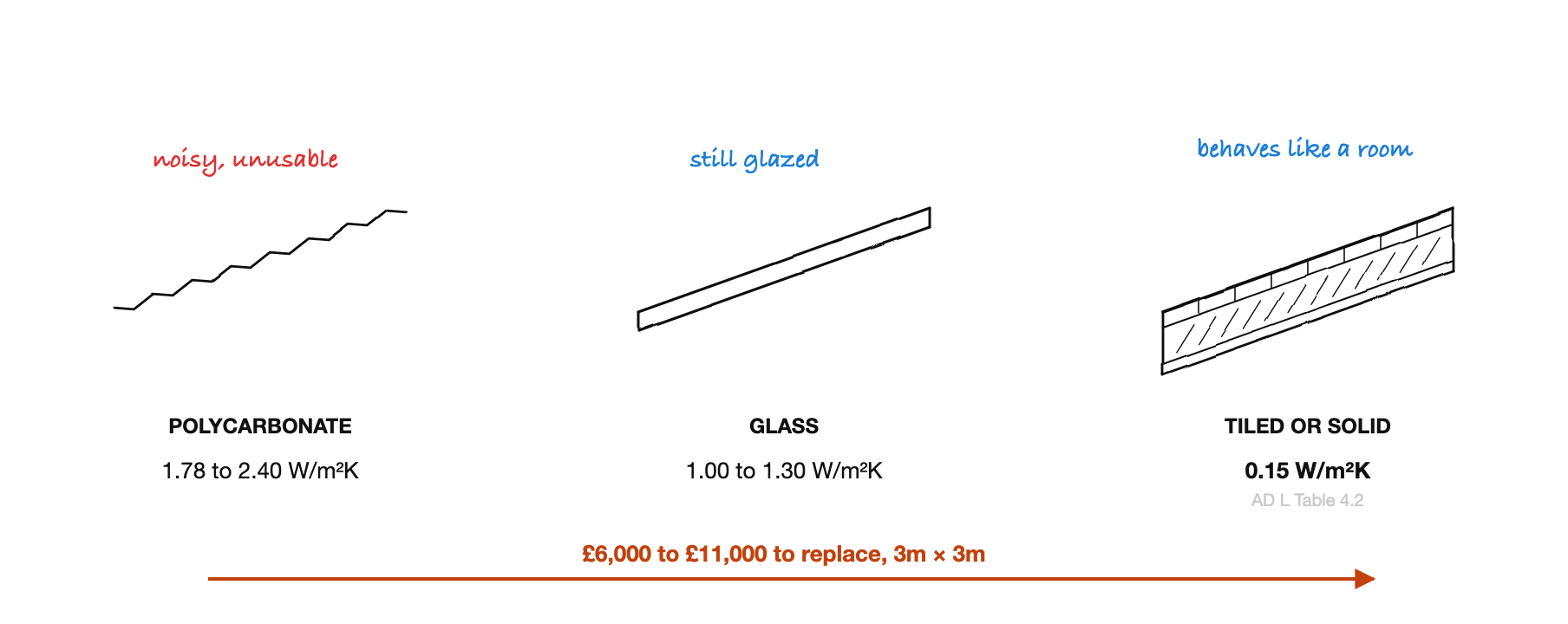
One rule before the table, because almost every page in this niche breaks it: a polycarbonate U-value depends on the number of walls in the sheet, not on its thickness. Two 16mm sheets differ by 0.6 W/m²K, from 2.4 for triplewall down to 1.78 for sevenwall. Anyone quoting a single figure against a thickness alone is quoting something they have not checked.
| Covering | Published U-value | What decides it | Source |
|---|---|---|---|
| Polycarbonate, whole market | 0.83 to 3.2 | Wall count, then thickness. 16mm alone spans 1.78 to 2.4 | Brett Martin, Palram, Arla Plast, Ultraframe technical data |
| Glass, sealed double-glazed unit | 1.0 to 1.3 | Coating, gas fill and spacer, not pane thickness | Clayton Glass published U-value table |
| Tiled, solid or warm system | 0.10 to 0.18 | Insulation type and thickness across the eight named systems | Manufacturer technical literature |
| Replacement roof, England | 0.15 maximum | The limiting value the work has to meet | Approved Document L Volume 1 2021, Table 4.2, p.25 |
Even the best polycarbonate on the UK market, a 55mm tenwall sheet at 0.83, is more than five times the 0.15 limiting value, and a retrofit insulated ceiling does not reach 0.15 either. Verified 20 August 2026.
Price your roof
Six questions, about sixty seconds, and an estimate built from the rows above with every source shown.
This page names the coverings. What yours costs turns on your size band, your existing frames and where you live, and the estimate is banded by size rather than multiplied out of a flat rate per square metre. Use price your conservatory roof, or get roof replacement quotes from local installers for real numbers against your own roof.
Check what your roof will cost
We are paid when an installer quotes you. That is the whole business model and it is why every figure on this page carries a source and a date rather than a headline.
Frame load and mullion reinforcement
Three of the seven words above describe roofs that weigh more than the one you have, which makes the frame rather than the covering the question that decides what is available to you. LABC's own guidance is more reassuring than the trade usually is: a lightweight composite solid roof adds approximately 0.5 kN/m, which LABC describes as less than 10 per cent over a typical translucent roof, and foundations are rarely the problem.
The real risk is invisible from outside: whether the existing mullions contain steel reinforcement. Frames built for a polycarbonate roof may have been reinforced only for that lighter load, and only pilot holes or a magnet test settle it. If the steel is not there, the fix runs £800 to £4,000, Reasonably evidenced but conflicted, from one UK publisher (May 2026, £800 to £2,500, reinforcing the existing frames) and a second (2026, £3,000 to £4,000, replacing them). Checked 20 August 2026. We attach no probability to it, because nobody publishes one.
When a roof change becomes regulated building work
Swapping a tired polycarbonate roof for a new polycarbonate or glass one is normally a like-for-like replacement on a structure that is still an exempt conservatory. Going opaque is a different act. Regulation 9(1)(b) keeps the exemption only while the structure is still the kind of building Schedule 2 describes, and the 2013 DCLG circular says it may no longer apply where the glazing to the walls or roof is significantly reduced. Once it stops being exempt the work is a material alteration under regulation 3(c), and the new roof has to reach 0.15 W/m²K.
Who signs it off is the part installers are vaguest about. It goes to Local Authority Building Control or a Registered Building Control Approver. No competent person scheme covers it. FENSA says in its own words that conservatories fall outside its scheme, and CERTASS lists porches and conservatories under what cannot be registered. CERTASS CQ-Assured does cover warm solid roof replacements, but it issues a Certificate of Conformity rather than a Building Regulations Compliance Certificate and does not notify your local authority. The fee runs £200 to £800, Reasonably evidenced but conflicted across two UK publishers (2026 and March 2026), checked 20 August 2026.
Questions people ask first
What is the best type of roofing for a conservatory?
What are conservatory roofs made of?
Is a warm roof the same as a tiled roof?
Which conservatory roof covering is cheapest?
Do I need building regulations approval to change my conservatory roof covering?
Can I get a grant to replace my conservatory roof?
Every figure on this page was last checked 20 August 2026, next check due 20 November 2026. Where a figure comes from a single publisher we grade it Thin; where two publishers disagree we publish both ends. See our conservatory cost calculator for the same rows applied to your own size band.
Find out what yours costs
Six questions, about sixty seconds, and an estimate built from published UK figures with every source shown. Then up to four local installers can quote you, if you want them to.